

What actually makes skin age?
Skin ages through two overlapping processes: intrinsic ageing, set by genetics and time, and extrinsic ageing, driven mainly by ultraviolet (UV) light, plus smoking, pollution and poor sleep. On the face, sun exposure accounts for much of what people call "ageing": lines, spots, dullness and loss of firmness.
Intrinsic ageing is gradual. From early adulthood, the skin makes less collagen and elastin each year, cell turnover slows and the skin becomes thinner and drier. There is little anyone can do to change that underlying pace.
Extrinsic ageing, often called photoageing, is different because much of it is preventable. UV rays break down collagen, disrupt pigment production and damage the small blood vessels near the surface. Dubai's UV index sits in the high to extreme range for much of the year, and many of our clients from Al Rashidiya, Mirdif and Festival City notice pigmentation and texture changes earlier than they expected.
Can lasers slow skin ageing?
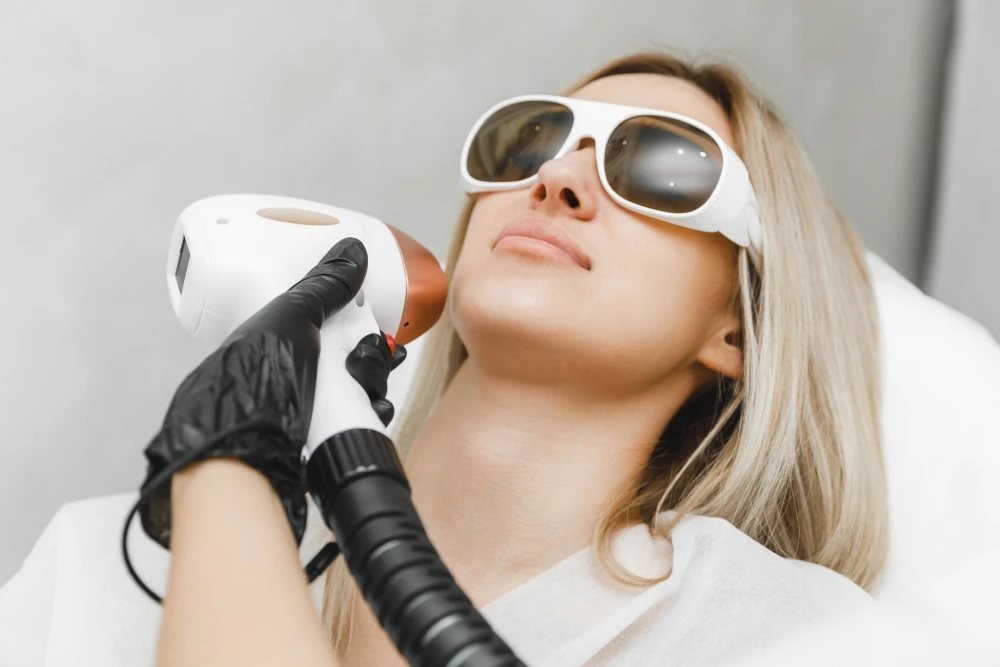
Lasers can't slow the biological ageing of your skin, but they can improve the visible signs of it. Energy-based treatments create controlled heat or micro-injury in the skin, which prompts a wound-healing response that includes fresh collagen. Over several months this can refine texture, soften fine lines and even out tone.
It helps to separate two ideas that marketing often blends together:
- Improving appearance. This is well supported. Peer-reviewed studies show that fractional lasers, some non-ablative lasers, microneedling and medium-depth peels can measurably improve photoaged skin.
- Changing how fast you age. This is not established. Your skin keeps ageing after treatment, and results fade gradually without sun protection and maintenance.
So the honest answer to "can lasers slow skin ageing?" is: they can help your skin look healthier and more even for longer, especially when you pair them with daily SPF. They are a way to repair some existing damage, not a way to turn back your biological clock.
Laser & More Clinic is a DHA-licensed aesthetic clinic in Al Rashidiya, Dubai. For skin concerns, our skin specialist starts with an analysis and a conversation about what you want to change before recommending chemical peels, Dermapen microneedling, HydraFacial, a medical facial or a carbon laser facial.
Should you trust "bio-age" and skin longevity claims?
Treat them with caution. There is no single validated test that measures your skin's "biological age" in a way that treatments can reliably reset. Skin-analysis cameras measure surface features such as spots, redness and pores, and epigenetic "clocks" are still research tools, not clinical measures of skin.
"Skin longevity" has become a popular phrase, and some of the science behind it is genuinely interesting. Researchers are studying how cells in skin age, how inflammation contributes, and whether certain ingredients or devices influence those processes. But interesting early research is a long way from proof that a facial or laser session adds healthy years to your skin.
When you see a claim such as "reduce your skin age by five years", ask three questions:
- What exactly was measured? A camera score, a wrinkle count, a blood test or a questionnaire all mean very different things.
- Compared with what? Without a control group, improvements could simply come from better skincare or a change of season.
- For how long? A result at two weeks tells you little about how skin looks two years later.
We use skin analysis to track visible concerns over time and to plan treatment. We don't use it to promise that your skin will become younger, and we'd encourage you to be wary of anyone who does.
Why does sun protection come first?
Sun protection comes first because UV exposure drives most visible facial ageing, and preventing new damage is easier than repairing it. A randomised trial in Australia found that adults who applied sunscreen daily showed no detectable increase in skin ageing over four and a half years, unlike those who used it at their own discretion.
No clinic treatment offers that kind of protection on its own. In fact, most rejuvenating treatments make skin temporarily more sensitive to the sun, so skipping SPF after a session can undo the benefit and raise the risk of pigmentation. Our everyday advice for Dubai skin:
- Use a broad-spectrum sunscreen of SPF 30 or higher every morning, including on cloudy days and indoors near windows.
- Reapply roughly every two hours outdoors, and after swimming or heavy sweating.
- Add shade, a wide-brimmed hat and sunglasses during the midday hours.
- Ask your specialist about evidence-based home care, such as a retinoid or antioxidant serum, used as advised for your skin.
Which works best: microneedling, peels or laser?
None is universally best. Microneedling suits texture, fine lines and mild scarring with a low risk of pigment change. Chemical peels suit dullness, uneven tone and superficial pigmentation. Laser and light-based treatments offer the most targeted control of heat for texture, tone and sun damage, but need careful settings on darker skin.
| Feature | Microneedling | Chemical peel | Laser / energy-based |
|---|---|---|---|
| How it works | Fine needles create micro-channels that trigger collagen repair | An acid solution removes damaged surface layers so fresher skin grows through | Light energy heats targeted layers or pigment to prompt repair and remodelling |
| Best for | Texture, fine lines, enlarged pores, mild acne scars | Dullness, uneven tone, superficial pigmentation, congestion | Sun damage, texture, tone, redness (depends on device) |
| Skin-type considerations | Generally suitable for all skin types | Strength must be matched to skin type; deeper peels need more caution | Settings and wavelength must be chosen carefully for darker skin |
| Recovery | Redness that usually settles quickly | From none to several days of flaking, depending on depth | Varies widely by device and intensity |
| Typical course | A series spaced weeks apart | A series spaced weeks apart | Assessed individually |
Microneedling
Microneedling uses a pen-like device with very fine needles to create thousands of tiny, controlled channels in the skin. Because it doesn't rely on heat, it carries a lower risk of pigment change, which makes it a common choice for darker skin types. Read more about Dermapen microneedling.
Chemical peels
Peels range from gentle superficial formulas with little downtime to deeper peels that need more preparation and recovery. Superficial and medium-strength peels are useful for brightening and evening tone. At Laser & More, we use TCA peels or bio-peels, chosen case by case after assessment. See our guide to chemical peels for how strengths differ.
Laser and light-based rejuvenation
Laser rejuvenation covers a family of treatments, from gentle non-ablative sessions that warm the deeper skin to more intensive fractional treatments. The right option depends on your concern, skin type and how much downtime you can accept. At Laser & More, skin rejuvenation is planned with peels, Dermapen, HydraFacial and medical facials, with the carbon laser facial for pores and oiliness. See our wider anti-aging treatment programme if you want a longer-term plan.
How long do results last?
Results build gradually and last months rather than forever. New collagen forms slowly over the months after a course, so improvements often continue after your last session. Because your skin keeps ageing and meeting the sun, most people choose periodic maintenance to hold on to the improvement.
What you can realistically expect depends on your starting point, your skin type and how consistently you protect your skin. Fine texture and dullness usually respond well. Deep folds and significant loss of volume are not something surface treatments can fix, and we will tell you honestly if another approach would suit you better. Results vary from person to person.
Who should be cautious with laser skin treatments?
People with darker skin, melasma, a recent tan, active skin infections or a history of poor healing should take extra care, as should anyone pregnant or taking medicines that increase light sensitivity. A consultation and skin assessment help identify these risks before treatment begins.
- Darker skin (Fitzpatrick IV–VI): higher risk of post-inflammatory hyperpigmentation, so conservative settings or non-heat options are often preferred.
- Melasma: heat can worsen it, so treatment is approached cautiously and sun protection is essential.
- Recent isotretinoin use: many practitioners advise waiting before resurfacing treatments. Tell us about any acne medication.
- Pregnancy and breastfeeding: we generally postpone elective treatments as a precaution.
What else do people ask about lasers and skin ageing?
Can lasers reverse ageing?
No. Lasers can improve visible signs such as texture, tone and fine lines, but they don't reverse the ageing process.
Think of treatment as repairing some existing damage. Daily sun protection and maintenance help the improvement last.
What age should I start laser skin treatments?
There's no set age. Daily SPF is worth starting as early as possible, while treatments make sense once a specific concern bothers you.
Many people first consider peels or microneedling in their late twenties or thirties for texture, pigmentation or early fine lines. A consultation helps decide what, if anything, you need.
Are laser skin treatments safe for darker skin?
They can be, when the device, wavelength and settings are chosen for your skin type and a licensed practitioner carries out the treatment.
Darker skin has a higher risk of temporary pigment changes, so settings need to be conservative. At your consultation, we may suggest non-heat options such as microneedling or a peel instead.
Does a skin analysis scan tell me my skin's biological age?
No. A skin analysis scan measures visible surface features such as spots, redness and pores, not biological age.
It's useful for planning treatment and tracking visible change over time, but any "skin age" number it shows is an estimate, not a medical measurement.
Sources and further reading
This article draws on general, publicly available guidance and peer-reviewed research. It is for information only and doesn't replace a personal consultation.
- American Academy of Dermatology (AAD): patient guidance on sunscreen, photoageing and laser resurfacing
- Hughes MCB, Williams GM, Baker P, Green AC. "Sunscreen and prevention of skin aging: a randomized trial." Annals of Internal Medicine, 2013
- British Association of Dermatologists (BAD): patient information on sun protection
- World Health Organization (WHO): guidance on the UV index
- Peer-reviewed dermatology journals, including Journal of Cosmetic Dermatology, Lasers in Surgery and Medicine and Dermatologic Surgery
- Dubai Health Authority (DHA): standards for licensed healthcare facilities
Written by the Laser & More clinical team, DHA-licensed nurses, laser specialists and our skin consultant in Al Rashidiya, Dubai.
Medically reviewed by Dr. Rabbia Shahnawaz · Published 28 September 2026 · Last updated 28 September 2026