
What is laser hair removal?
Laser hair removal is a medical aesthetic treatment that uses concentrated light to reduce unwanted hair over a course of sessions. Unlike shaving or waxing, which only remove hair at or above the skin, the laser works on the follicle beneath the surface, so regrowth becomes slower, finer and sparser over time.
The word "laser" describes a very specific kind of light: a single wavelength, travelling in one direction, delivered in controlled pulses. That precision is what lets a trained practitioner heat a hair follicle a few millimetres under the skin while leaving the surrounding tissue largely untouched.
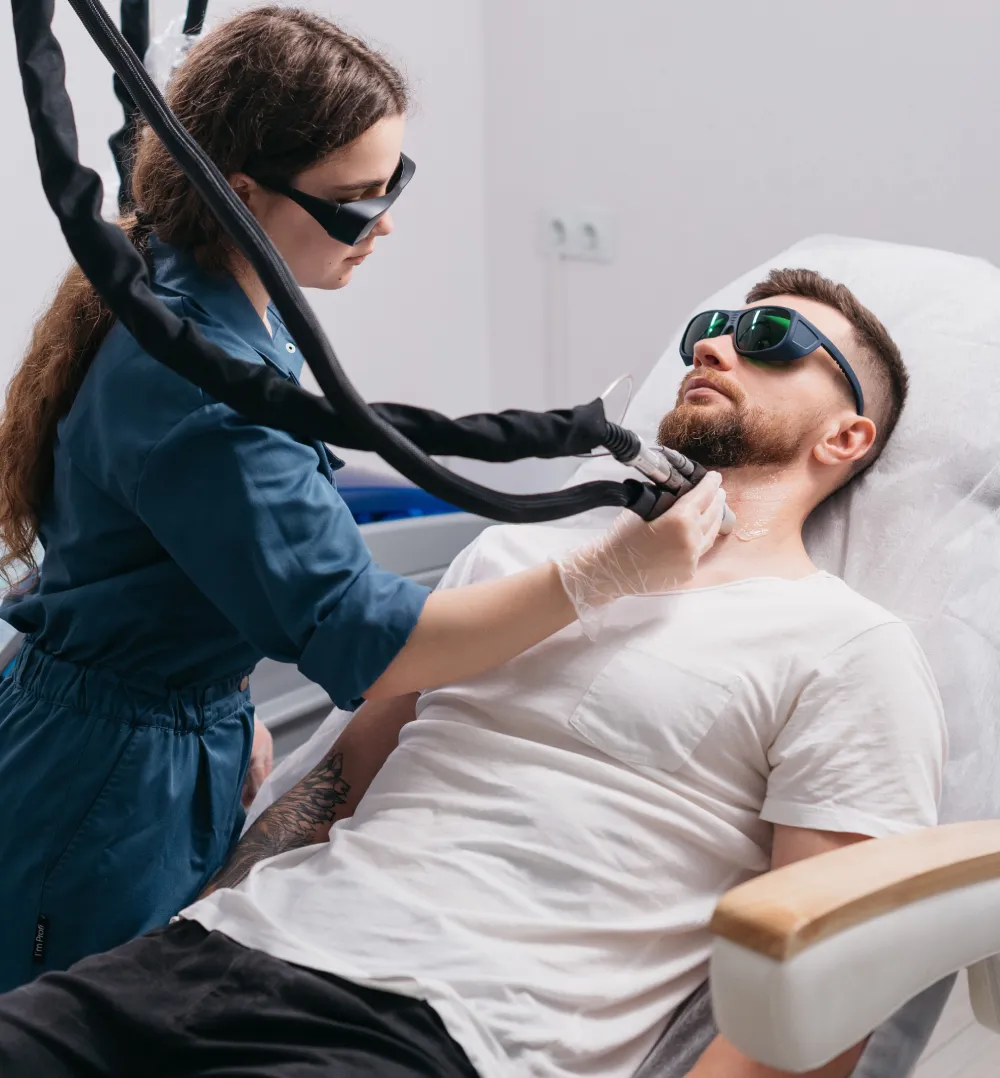
Laser & More Clinic is a DHA-licensed aesthetic clinic in Al Rashidiya, Dubai, using the Candela GentleMax Pro laser. Treatments are carried out by licensed nurses and laser specialists after a consultation and skin assessment. Many of our clients from Mirdif, Deira and Al Warqa come to us after years of razor burn and ingrown hairs, which Dubai's heat and humidity tend to make worse.
How does the laser destroy the hair follicle?
The laser damages the follicle through a process called selective photothermolysis. Light of a specific wavelength is absorbed by melanin in the hair shaft, converted to heat, and conducted to the surrounding cells that drive regrowth, while the lighter skin around it absorbs far less of that energy.
Selective photothermolysis in plain English
The term breaks down neatly: selective (it targets one thing), photo (light), thermo (heat) and lysis (breakdown). The principle was first described in 1983 by researchers at Massachusetts General Hospital, and it still underpins every medical hair-removal laser today. It relies on getting three settings right:
- Wavelength. The colour of the light decides what absorbs it and how deep it travels. Hair-removal wavelengths are chosen because melanin absorbs them well and they reach the depth of the follicle.
- Pulse duration. The pulse must be long enough to heat the whole follicle, but short enough that the heat doesn't spread into the skin around it.
- Energy (fluence). Enough energy disables the follicle; too much risks the skin. Your specialist matches this to your skin and hair, and adjusts it from session to session.
Why melanin matters
Melanin is the pigment that gives hair and skin their colour. The laser can't "see" a hair, only its pigment. That's why dark, coarse hair on lighter skin gives the strongest contrast and the fastest results. When skin is darker, it contains more melanin too, so the laser has to be chosen and set carefully to avoid heating the skin instead of the hair. Blonde, grey, white and most red hairs contain too little of the right pigment to absorb enough energy, so laser works poorly or not at all on them.
The anagen phase
Every hair grows in a cycle. In the anagen phase it is actively growing and firmly connected to the blood supply at the base of the follicle. In the catagen phase it detaches, and in the telogen phase it rests before shedding. The laser is most effective during anagen, when the hair is pigmented and still attached, so heat travels down the shaft to the cells that matter.
Why do you need multiple sessions?
You need multiple sessions because at any moment only a fraction of your hairs are in the anagen (active growth) phase, the only stage in which the follicle is reliably disabled. Spacing sessions 3–4 weeks apart catches new groups of hairs as they enter growth, building reduction session by session.
Most clients need 6–8 sessions. Coarse hair on the underarms and legs often responds quickly. Facial hair, and hair driven by hormones such as in PCOS, usually needs more sessions and occasional top-ups. Here is what a typical course feels like:
- After each session, treated hairs shed on their own over one to three weeks. It can look like regrowth at first, but these hairs slide out easily.
- In the early sessions, regrowth slows and becomes patchy.
- By the middle of the course, most clients notice finer, lighter and far fewer hairs.
- After the final session, you move to occasional maintenance if and when new growth appears.
Between sessions, shaving is fine, but avoid waxing, plucking and threading. They pull out the root the laser needs to target. You'll find a full list in our pre- and post-care FAQs.
What's the difference between 755nm Alexandrite and 1064nm Nd:YAG?
The 755nm Alexandrite wavelength is strongly absorbed by melanin, making it fast and effective for light to olive skin with dark hair. The 1064nm Nd:YAG wavelength is absorbed less by melanin and penetrates deeper, so it bypasses more surface pigment and is the safer choice for darker skin and deep-rooted hair.
| Feature | Alexandrite 755nm | Nd:YAG 1064nm |
|---|---|---|
| Melanin absorption | High | Lower |
| Penetration depth | Moderate | Deep |
| Best-suited skin types | Fitzpatrick I–IV (fair to olive) | Fitzpatrick IV–VI (olive to deep), also used on lighter skin |
| Hair types | Fine to coarse dark hair | Coarse, dense, deep-rooted hair |
| Typical areas | Face, underarms, arms, legs | Back, chest, beard line, bikini on darker skin |
| How it feels | Quick snap; cooling keeps it comfortable | Can feel warmer; cooling keeps it manageable |
The Candela GentleMax Pro contains both lasers in one machine, so you don't have to choose a clinic based on its equipment. Your specialist selects the wavelength for each area. Some clients use both over one course, for example Alexandrite on fine facial hair and Nd:YAG on coarse hair across the back. Large spot sizes also help the laser reach the follicle efficiently and cover big areas faster. Read more about the device on our technology page.
Does laser hair removal work on dark skin?
Yes. Laser hair removal works on dark skin when the right wavelength and settings are used. The 1064nm Nd:YAG laser passes through melanin-rich skin with less absorption at the surface, so it can target the follicle while lowering the risk of burns and pigment changes.
Dermatologists describe skin using the Fitzpatrick scale, from type I (very fair, always burns) to type VI (deeply pigmented, rarely burns). Older devices and many IPL machines were designed with lighter skin in mind, which is where laser's reputation for being unsuitable for darker skin came from. Dubai's population covers the whole scale, so we assess every client individually.
For darker skin, we usually choose the 1064nm Nd:YAG wavelength, start with conservative settings and adjust them gradually from session to session. Avoid tanning and self-tan before sessions, because extra surface pigment raises the risk of post-inflammatory hyperpigmentation (temporary dark patches). You can read more in our safety FAQs.
How does cooling protect the skin?
Cooling protects the skin by lowering the temperature of its outer layer just before each pulse, so heat stays concentrated in the follicle rather than the surface. On the GentleMax Pro, the Dynamic Cooling Device (DCD) releases a short burst of cryogen spray milliseconds before the laser fires.
This matters for two reasons. First, comfort: most clients describe each pulse as a quick snap, like a rubber band flick, and cooling takes the edge off. Second, safety: by protecting the top layer of skin, cooling allows the specialist to use effective energy levels with a lower risk of surface burns. Other clinics may use contact cooling plates or cold-air blowers; the DCD is timed automatically with each pulse, so every spot gets the same protection.
How long do results last?
Results are long-term. After a completed course, most treated follicles produce little or no hair for years, and any regrowth tends to be finer and lighter. Device studies report up to 90% reduction after a full course, though results vary by area, hair colour and hormones.
Dermatology bodies describe the outcome as a reduction in hair, not the removal of every hair forever. Hormonal changes, such as PCOS, pregnancy, menopause or some medications, can activate follicles that were dormant during your course. That's why many clients book one or two top-up sessions a year. At your consultation we'll talk through realistic expectations for your skin, hair and treatment area.
Is laser hair removal safe?
Laser hair removal is considered safe when performed by trained, licensed practitioners using medical-grade equipment and settings matched to your skin. Common side effects are temporary redness and mild swelling around the follicles. Burns, blistering and pigment changes are uncommon and are usually linked to incorrect settings or tanned skin.
Expect slight redness, similar to mild sun exposure, that usually fades within a few hours. To keep risks low we:
- Review your medical history and medication, as some drugs make skin more sensitive to light
- Assess your skin type and hair before your first session, and adjust settings from session to session
- Provide protective eyewear for you and your specialist
- Pause treatment during pregnancy and breastfeeding as a precaution
- Avoid treating over active infections, open wounds or recently tanned skin
Laser treatments in Dubai must take place in a facility licensed by the Dubai Health Authority (DHA). Ask to see your practitioner's licence if you're unsure. For more on why reactions happen and how to avoid them, see our guide to laser hair removal burns, or explore the full laser hair removal service.
What else do people ask about laser hair removal?
Does laser hair removal hurt?
Most people feel a quick snap, like a rubber band flick, with the Dynamic Cooling Device keeping discomfort low.
Sensitive areas such as the upper lip or bikini line can feel sharper. Your specialist can adjust settings and cooling at any time.
Can laser remove blonde, grey or red hair?
Usually not well, because blonde, grey, white and most red hairs lack the melanin the laser needs to absorb.
We'll assess your hair colour at the consultation and tell you honestly whether laser is likely to work for you.
Why do treated hairs still appear after a session?
Treated hairs are pushed out of the follicle over one to three weeks, so they can look like regrowth before they shed.
Let them fall out on their own, or shave. Don't pull them out, as that removes hairs the laser has already treated.
Can I shave between laser sessions?
Yes, shaving is the recommended way to manage hair between sessions.
Avoid waxing, plucking, threading and epilators, which remove the root the laser needs to target at your next visit.
Sources and further reading
This article draws on general, publicly available guidance and peer-reviewed research. It is for information only and doesn't replace a personal consultation.
- American Academy of Dermatology (AAD): patient guidance on laser hair removal
- Anderson RR, Parrish JA. "Selective photothermolysis: precise microsurgery by selective absorption of pulsed radiation." Science, 1983
- NHS (UK): guidance on cosmetic laser hair removal
- Peer-reviewed dermatology and laser journals, including Lasers in Surgery and Medicine and Dermatologic Surgery
- Candela: GentleMax Pro technical information
- Dubai Health Authority (DHA): standards for licensed healthcare facilities
Written by the Laser & More clinical team, DHA-licensed nurses and laser specialists in Al Rashidiya, Dubai.
Medically reviewed by Dr. Rabbia Shahnawaz · Published 28 September 2026 · Last updated 28 September 2026